
SEO Is Dying. AI Retrieval Infrastructure Is Replacing It.
EverSwift Labs CEO & Founder
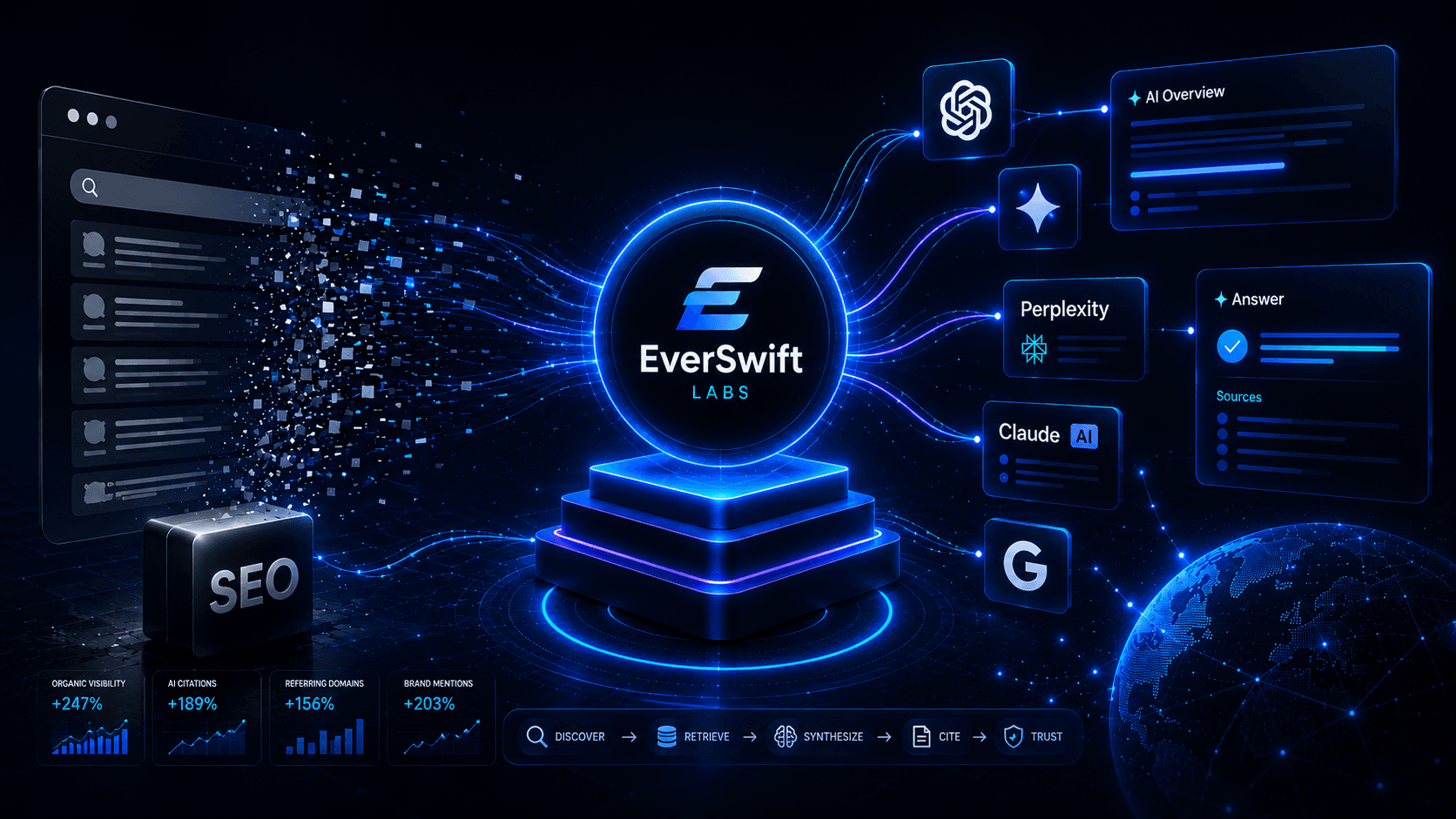
Search is no longer a list of blue links.
That era is ending faster than most companies realize.
Users increasingly discover information through:
- ChatGPT
- Google AI Overviews
- Perplexity
- Claude
- Gemini
This changes everything about how modern software companies acquire traffic.
Traditional SEO optimized websites for:
- rankings
- clicks
- backlinks
- keyword density
Modern AI retrieval systems optimize for:
- structured information
- semantic clarity
- authoritative sources
- answer extraction
- contextual understanding
The difference is massive.
Most companies are still optimizing for search engines.
The next generation of companies will optimize for:
answer engines.
And those are not the same thing.
The Shift Most Companies Haven’t Understood Yet
Traditional search worked like this:
User Query
↓
Search Engine Rankings
↓
List of Websites
↓
User Clicks Result
AI retrieval works differently.
User Query
↓
AI Retrieval System
↓
Answer Synthesis
↓
Source Extraction
↓
Direct Response
This changes website architecture completely.
The objective is no longer:
“Get the click.”
The objective becomes:
“Become the source the AI trusts.”
That requires an entirely different infrastructure strategy.
Why Traditional SEO Content Is Breaking
Most SEO content today is structurally weak.
It is:
- repetitive
- bloated
- generic
- optimized for algorithms instead of humans
- written to manipulate rankings
AI systems increasingly ignore low-signal content.
Why?
Because answer engines prioritize:
- clarity
- structure
- semantic organization
- factual density
- expertise
- directness
This is why thousands of AI-generated blogs are already becoming invisible.
The web is entering a signal compression era.
Low-quality content abundance reduces visibility for everyone.
What AI Retrieval Systems Actually Prefer
Modern answer engines favor content that is:
Structured
Bad:
Creative vague headings
Long unstructured paragraphs
Keyword stuffing
Good:
What Is AEO?
How AI Retrieval Works
Why Semantic HTML Matters
Structure improves machine understanding.
Semantic
Use proper HTML:
<article>
<section>
<header>
<nav>
<main>
Avoid:
- div soup
- excessive nesting
- unclear layouts
Semantic structure helps AI systems understand relationships between content blocks.
Direct
Most blogs waste the first 800 words saying nothing useful.
AI systems prioritize:
- immediate answers
- concise explanations
- contextual clarity
Example:
Bad:
“In today’s rapidly evolving digital ecosystem…”
Good:
“AI search engines retrieve structured answers instead of ranking links.”
Clarity wins.
Why AEO Is Becoming Critical
AEO stands for:
Answer Engine Optimization
It focuses on making content:
- retrievable
- understandable
- extractable
- quotable by AI systems
This includes:
- ChatGPT
- Perplexity
- Claude
- Gemini
- Google AI Overviews
Most companies are not preparing for this transition.
That creates a massive opportunity.
The New Traffic Model
Traditional traffic:
Google Search
↓
Website Click
↓
Conversion
Modern discovery:
AI Query
↓
Answer Generation
↓
Source Citation
↓
Authority Recognition
↓
Traffic + Brand Trust
This means:
discoverability is becoming infrastructure.
Not marketing.
How We’re Building for AI Retrieval at Everswift Labs
At Everswift Labs, we treat AI discoverability as a systems problem.
Every page is optimized for:
- semantic clarity
- structured retrieval
- metadata accuracy
- answer extraction
- contextual indexing
This changes how we build:
- blogs
- tools
- landing pages
- documentation
- playbooks
Structured data improves:
- indexing
- AI interpretation
- answer extraction
- citation probability
The Future Belongs to Retrieval-Native Websites
Most websites today are:
SEO-first.
Modern infrastructure should be:
retrieval-first.
That means:
- semantic architecture
- structured systems
- clear hierarchy
- direct explanations
- operational depth
This is why:
- playbooks
- technical documentation
- frameworks
- systems diagrams
are becoming more valuable than generic blog content.
AI systems prefer high-signal information.
Free Tools Are Becoming Distribution Engines
This is another major shift.
Modern software companies increasingly grow through:
- utility
- tools
- operational assets
- calculators
- generators
- frameworks
Why?
Because tools generate:
- backlinks
- recurring traffic
- AI citations
- authority signals
- distribution loops
A single useful tool can outperform hundreds of generic blog posts.
This is why Everswift Labs prioritizes:
- operational tools
- validation systems
- workflow utilities
- automation infrastructure
instead of publishing low-value content at scale.
Why Most AI Content Strategies Will Fail
Most AI content pipelines optimize for:
- volume
- speed
- publishing frequency
That creates:
- redundancy
- low originality
- weak signal quality
The future advantage belongs to companies that optimize for:
- operational depth
- structured expertise
- retrieval quality
- information density
Not content spam.
The New Content Stack
The modern content stack looks like this:
Operational Systems
↓
Structured Knowledge
↓
Semantic Content
↓
AI Retrieval
↓
Authority Compounding
↓
Organic Distribution
This is fundamentally different from traditional SEO.
The companies that understand this shift early will build enormous long-term advantages.
Practical AEO Checklist
1. Use Semantic HTML
<main>
<article>
<section>
<h1>
<h2>
2. Add Structured Metadata
Use:
- JSON-LD
- Open Graph
- metadata APIs
3. Write Retrieval-Friendly Headings
Bad:
- “Thoughts on the Future”
Good:
- “How AI Retrieval Systems Rank Content”
4. Answer Questions Immediately
Avoid long introductions.
Deliver useful information quickly.
5. Build High-Signal Assets
Examples:
- tools
- playbooks
- frameworks
- architecture guides
- operational documentation
The Most Important Insight
AI will not eliminate websites.
But it will eliminate:
- low-signal content
- weak information
- generic SEO spam
The future belongs to:
- structured expertise
- retrieval-native systems
- operational authority
This transition is already happening.
Most companies simply have not noticed yet.
Final Thoughts
Search is evolving from:
ranking pages
to:
retrieving answers.
That changes:
- website architecture
- content strategy
- SEO infrastructure
- authority building
- software distribution
The companies that adapt early will compound visibility for years.
The companies that continue publishing generic content will slowly disappear from retrieval systems entirely.
This is not just an SEO shift.
It is a structural shift in how the internet distributes information.
And increasingly: the companies that win will not be the companies that publish the most content.
They will be the companies that build the best retrieval infrastructure.
Get the next one first.
New writing on AI systems, distribution and building solo. No spam, unsubscribe in one click.