
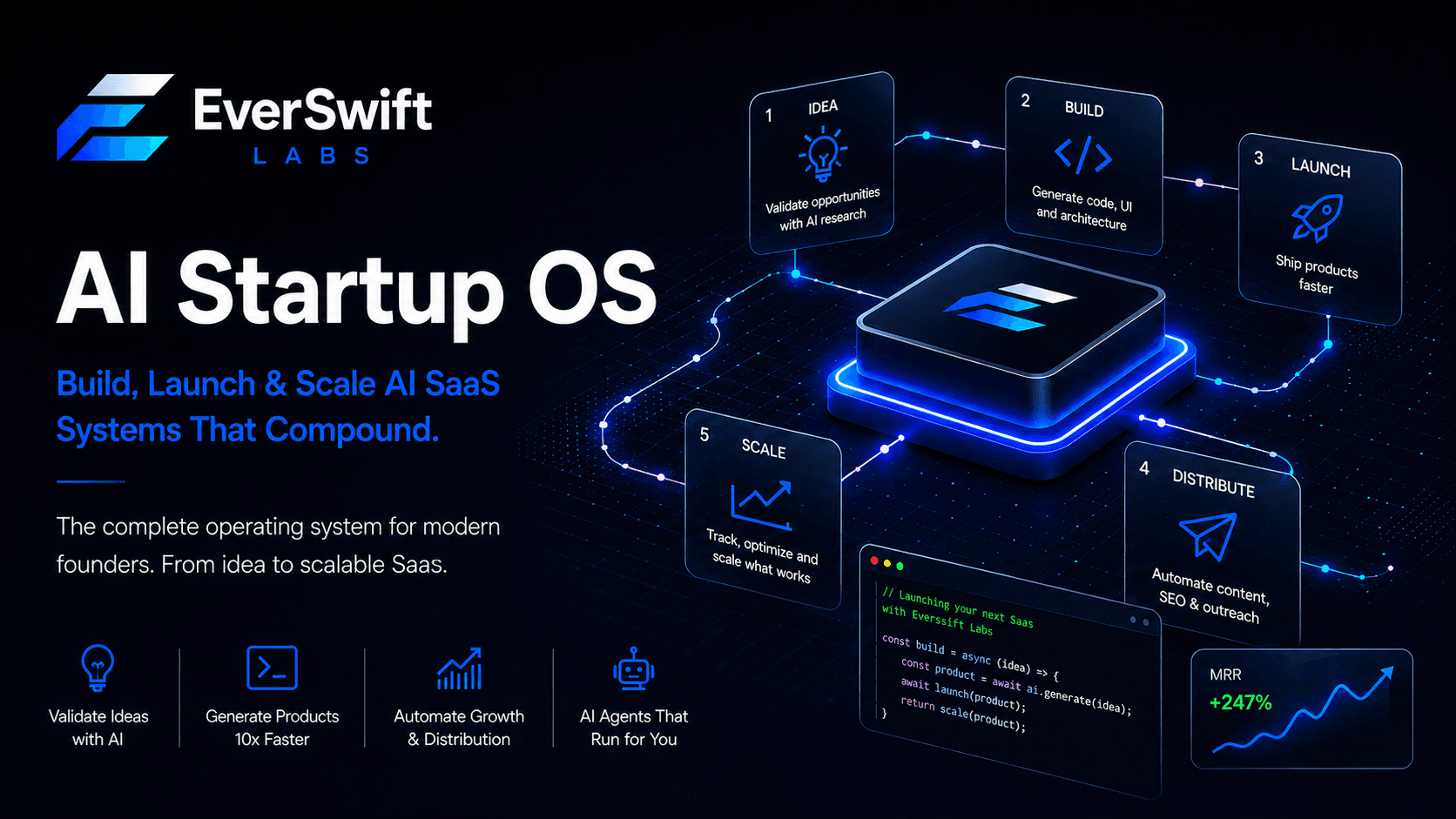
Everswift Labs Startup OS
EverSwift Labs CEO & Founder
More playbooks like this.
Long-form breakdowns of how the work actually gets done. Occasional, not weekly.
EverSwift Labs CEO & Founder
Long-form breakdowns of how the work actually gets done. Occasional, not weekly.
Modern founders are operating billion dollar ambitions through a Frankenstein stack of disconnected tools.
Ideas live in notes apps. Validation happens in ChatGPT tabs. Roadmaps sit inside project managers. Distribution runs through spreadsheets. Feedback gets buried in Discord threads, support inboxes, analytics dashboards, and screenshots.
The startup itself becomes fragmented before the product is even launched.
That fragmentation is now one of the biggest hidden taxes in modern software building.
EverSwift Startup OS was built to solve that.
Not as another SaaS dashboard.
But as an operating system for startup execution.
The modern startup workflow is operational chaos disguised as productivity.
A founder typically jumps between:
All just to move one idea from:
Concept
→ Validation
→ Planning
→ Building
→ Launch
→ Growth
The problem is not that these tools are bad.
The problem is that none of them understand the startup itself.
They understand tasks. Not execution.
Most software categories were designed around teams:
But founders sit above all of those layers simultaneously.
A founder is:
Traditional SaaS software forces founders to constantly context-switch between systems that do not share memory, priorities, or strategic understanding.
That creates:
The bigger the startup becomes, the worse the fragmentation gets.
AI accelerated output.
But it did not solve orchestration.
Most AI tools today still behave like isolated assistants:
That is not an operating system.
That is autocomplete.
The missing layer is workflow intelligence.
Software that understands:
That is the shift EverSwift Startup OS is designed around.
Traditional SaaS products think in pages.
EverSwift Startup OS thinks in workflows.
The system continuously moves founders through an execution cycle:
Signals
→ Validation
→ Planning
→ Building
→ Distribution
→ Maintenance
→ Learning
Every module feeds the next one.
Every decision compounds.
Every output becomes memory.
The startup itself becomes a living operational graph instead of disconnected documents and dashboards.
Most startup software feels like administration software.
Too many tables. Too many settings. Too many nested pages. Too much operational friction.
The EverSwift Startup OS is built around a completely different UX philosophy:
The founder should always know exactly what matters next.
That changes everything.
The interface is designed like a cinematic command center:
The goal is not to impress users with complexity.
The goal is to eliminate chaos.
Modern SaaS UX has a hidden disease: feature accumulation.
Products keep adding:
Until the software becomes operational noise.
Founders do not need more surfaces.
They need more clarity.
That is why EverSwift Startup OS is built with workflow-first UX:
Most founders start with assumptions.
Startup Radar starts with signal intelligence.
The Radar continuously monitors:
Then filters for:
Instead of generic “startup ideas,” founders get:
The difference matters.
Ideas are random. Signals are directional.
Most founders do not fail because they cannot build.
They fail because they build the wrong thing.
Startup Validator exists to prevent that.
The system analyzes:
The output is intentionally direct.
Not motivational.
Not “AI positivity.”
Just strategic clarity.
Because spending:
That asymmetry is enormous.
Traditional planning tools focus on task organization.
EverSwift Startup OS focuses on execution sequencing.
The system understands:
Instead of static roadmaps, founders get:
The difference is subtle but important.
A roadmap shows tasks.
An operating system shows momentum.
Software development itself is changing.
Founders are moving from:
Writing everything manually
To:
Orchestrating systems intelligently
The Builder layer inside EverSwift Startup OS coordinates:
The founder becomes less of a manual executor and more of a systems architect.
That transition is happening across the industry.
EverSwift Startup OS is designed around that future.
The internet has changed.
Building is cheaper than ever.
Attention is not.
The biggest bottleneck for modern startups is no longer development.
It is distribution.
That is why Distribution Engine exists inside the OS itself instead of as an external marketing tool.
The system helps founders orchestrate:
Because products without distribution are invisible infrastructure.
Most software forgets everything.
EverSwift Startup OS does not.
The system stores:
That persistent memory becomes strategic leverage.
The OS compounds context over time.
Which means the startup itself becomes increasingly intelligent as it operates.
This is one of the biggest architectural shifts in modern software: from tools that store files to systems that understand execution history.
The industry is currently obsessed with AI agents.
But agents without orchestration become chaos very quickly.
The important question is not:
“Can the AI do something?”
The important question is:
“Does the system know when, why, and how that action should happen?”
That requires:
EverSwift Startup OS is not designed as a collection of disconnected agents.
It is designed as a coordinated operational system.
That distinction matters.
A lot.
The next generation of startup software will not look like:
It will look like operational intelligence systems.
Systems that understand:
Software will shift from:
Tool interfaces
To:
Execution systems
That is where the market is heading.
And that is what EverSwift Startup OS is built for.
Most founders do not need more tools.
They need:
The startup ecosystem has spent years optimizing software for departments.
EverSwift Startup OS is optimizing software for founders.
That is the difference.
And over the next decade, that difference is going to matter a lot.
EverSwift Startup OS is a workflow-first startup execution platform that helps founders move from:
inside one connected operational system.
Unlike traditional SaaS dashboards, the OS is designed around execution workflows instead of isolated tools.
No.
Most AI wrappers generate:
EverSwift Startup OS focuses on:
The system coordinates:
The goal is not isolated generation.
The goal is:
Traditional startup tools are fragmented.
Founders typically use:
that do not share context.
EverSwift Startup OS centralizes:
into one coordinated environment.
The platform currently includes:
Startup Radar is the market intelligence layer inside the OS.
It continuously analyzes:
to identify high-potential startup opportunities.
Startup Validator evaluates:
before founders invest months building the wrong thing.
Because startups fail from:
not just lack of features.
The OS is designed to continuously guide founders toward:
Not directly.
Traditional project management software organizes tasks.
EverSwift Startup OS orchestrates:
The philosophy is fundamentally different.
The system stores:
This allows every module to reuse startup intelligence instead of operating in isolation.
Most software forgets everything between actions.
Shared memory allows the OS to:
over time.
This becomes increasingly valuable as startups scale.
No.
The product is intentionally designed with:
so both:
can navigate execution more effectively.
Distribution Engine analyzes:
to help founders realistically acquire customers.
Yes.
The Builder layer helps coordinate:
But the emphasis is on:
Not blind code generation.
Most SaaS software creates:
The redesign philosophy behind EverSwift Startup OS prioritizes:
The system should feel:
Partially.
But EverSwift Startup OS is not simply:
The important layer is orchestration:
Agents without orchestration create chaos.
The OS coordinates them operationally.
The platform solves:
It reduces:
by turning startup building into:
The long-term vision is to create:
A system that understands:
and continuously helps founders execute with greater clarity and leverage.