
EverSwift Labs Logo
EverSwiftLABS
Operational Playbook

Distribution Decides Whether Startups Survive

EverSwift Labs CEO & Founder
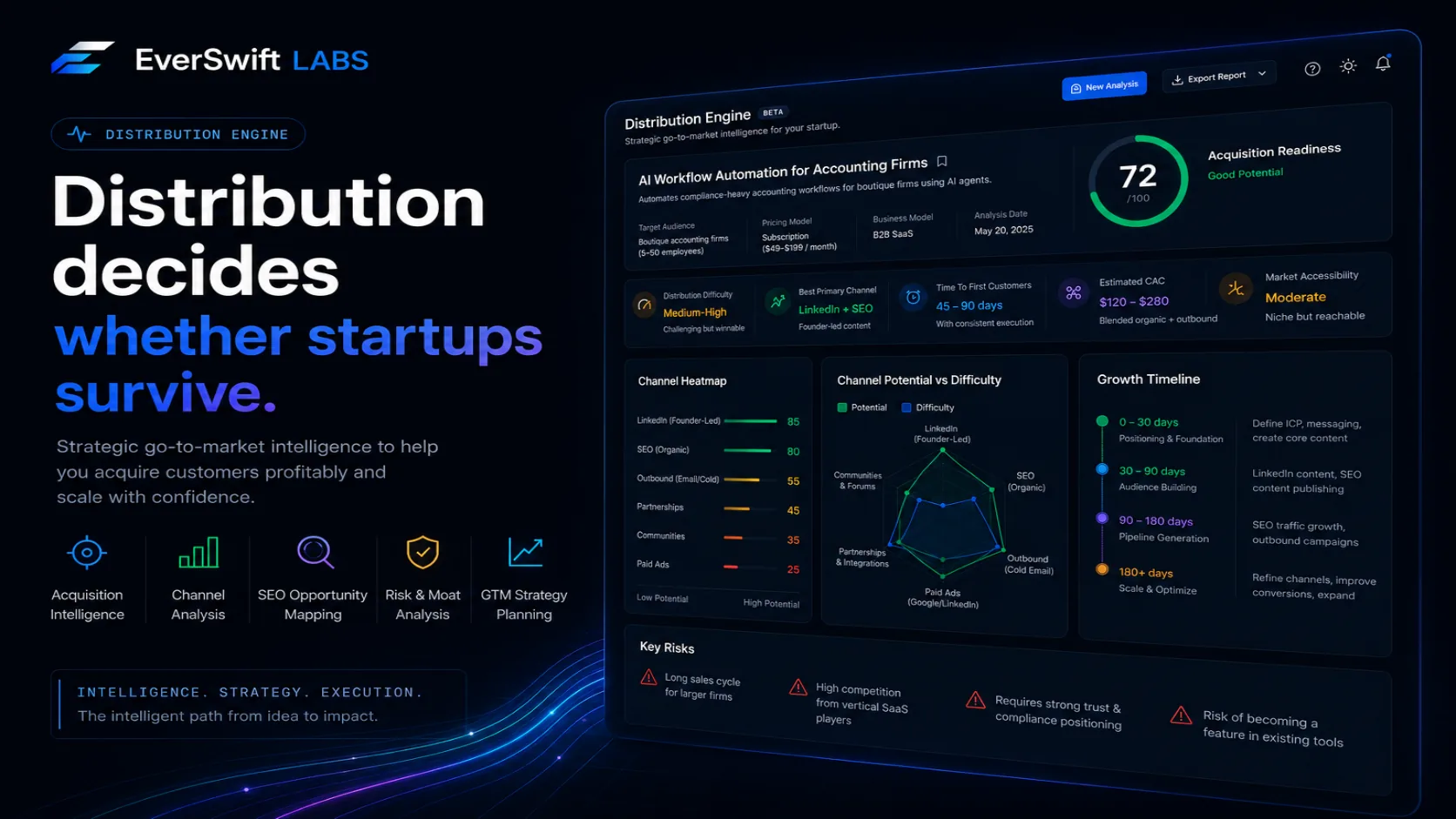
Distribution Decides Whether Startups Survive

The Everswift Distribution Intelligence Framework

Most founders massively underestimate distribution.

Not because they ignore marketing.

But because they fundamentally misunderstand:

how startups actually acquire customers.

Modern SaaS execution is no longer constrained by:

  • engineering
  • infrastructure
  • deployment
  • AI capability

The bottleneck is now:

customer acquisition efficiency.

A mediocre product with elite distribution often wins.

A technically brilliant product with weak distribution usually dies quietly.

This is why most startups fail AFTER building.

Not before.


The Problem With Traditional Startup Marketing Advice

Most startup growth advice is structurally useless.

Founders are told to:

  • “post on LinkedIn”
  • “do SEO”
  • “run ads”
  • “go viral”
  • “build community”

without understanding:

  • channel-market fit
  • founder leverage
  • CAC structure
  • audience behavior
  • distribution timing
  • acquisition scalability

This creates:

random acts of marketing.

Not operational distribution systems.

The result:

  • inconsistent growth
  • expensive acquisition
  • weak retention loops
  • unsustainable CAC
  • low authority positioning

The Everswift Distribution Engine exists to solve this.


What Distribution Engine Actually Does

Distribution Engine is not:

  • a marketing generator
  • an AI copywriter
  • a social media tool

It is:

a strategic go-to-market intelligence system.

The platform analyzes:

  • acquisition feasibility
  • founder leverage
  • channel viability
  • SEO opportunity
  • customer accessibility
  • CAC risk
  • growth scalability
  • distribution defensibility

The goal is not to generate “content.”

The goal is to determine:

whether a startup can realistically acquire customers profitably.


The Core Thesis

Every startup has:

  • a product-market fit layer and:
  • a distribution-market fit layer

Most founders only think about the first one.

That is a catastrophic mistake.

Because:

Code
A startup with weak distribution mechanics will fail even with strong product quality.

Distribution Engine exists to evaluate:

distribution-market fit.


The Everswift Distribution Workflow

The platform treats startup growth as:

operational systems engineering.

Not content creation.

The workflow:

Code
Startup Idea
↓
Market Validation
↓
Distribution Analysis
↓
Channel Feasibility
↓
Acquisition Risk Mapping
↓
GTM Motion Selection
↓
Launch Strategy
↓
Scalable Customer Acquisition

This transforms growth from:

  • reactive experimentation to:
  • structured execution infrastructure.

Why Distribution Fails For Most Founders

Most startups fail distribution because:

  • acquisition channels are saturated
  • founder positioning is weak
  • customer pain lacks urgency
  • CAC exceeds monetization potential
  • audiences are difficult to access
  • distribution loops do not compound

Founders often mistake:

  • visibility for:
  • scalable acquisition.

Distribution Engine attempts to expose these structural weaknesses BEFORE execution begins.


Distribution Engine Architecture

Founder Inputs

The system evaluates startups using structured operational inputs.

Users provide:

  • startup idea
  • target audience
  • pricing model
  • founder advantages
  • budget constraints
  • acquisition preferences
  • growth style preferences

These inputs dramatically affect:

  • acquisition feasibility
  • growth speed
  • CAC structure
  • authority potential

Acquisition Readiness Analysis

The engine generates:

Acquisition Readiness Scores.

This score estimates how realistically the startup can:

  • attract attention
  • acquire customers
  • build authority
  • scale distribution efficiently

The score is influenced by:

  • urgency
  • market accessibility
  • acquisition competition
  • founder leverage
  • content scalability
  • organic discovery potential

Distribution Difficulty Mapping

One of the most important systems inside Distribution Engine is:

Distribution Difficulty Analysis.

Some startups are easy to distribute.

Others require:

  • enterprise trust
  • long sales cycles
  • outbound infrastructure
  • high-authority positioning
  • network access

The engine surfaces this reality directly.

Example outputs:

  • Low
  • Moderate
  • High
  • Extreme

This prevents founders from underestimating:

execution complexity.


Primary Channel Intelligence

Most startups should NOT attempt every acquisition channel simultaneously.

Distribution Engine identifies:

the highest-leverage acquisition path.

Examples:

  • SEO-first
  • Founder-led LinkedIn
  • Outbound-heavy
  • Product-led growth
  • Community-led distribution
  • Partnership-driven growth

The system explains:

  • why the channel fits
  • how difficult it is
  • expected ramp time
  • long-term scalability

Channel-Market Fit

A critical concept inside the platform is:

channel-market fit.

Different markets behave differently.

Examples:

Developer Tools

Best channels:

  • Twitter/X
  • HackerNews
  • technical SEO
  • GitHub visibility

Enterprise SaaS

Best channels:

  • outbound sales
  • LinkedIn authority
  • partnerships
  • webinars
  • niche SEO

AI Workflow SaaS

Best channels:

  • educational content
  • operational teardown content
  • AI search visibility
  • founder-led authority

Distribution Engine attempts to map:

  • audience behavior to:
  • optimal acquisition systems.

SEO Opportunity Mapping

Modern SaaS growth increasingly depends on:

search infrastructure.

Especially:

  • Google
  • AI Overviews
  • ChatGPT retrieval
  • Perplexity citations
  • semantic search systems

Distribution Engine evaluates:

  • keyword opportunity density
  • topical authority potential
  • AI Overview competition
  • search intent quality
  • SEO saturation

This helps founders identify:

scalable organic acquisition paths.


Long-Tail Opportunity Discovery

The system heavily prioritizes:

long-tail search opportunities.

Because modern SEO is no longer dominated by:

  • broad keywords

Instead:

  • operational intent
  • workflow-specific queries
  • niche pain points
  • AI-assisted retrieval systems

Examples:

Code
"AI compliance workflow automation for accountants"

is often far more valuable than:

Code
"AI automation software"

The engine identifies these asymmetrical acquisition opportunities.


Founder Advantage Analysis

Most founders ignore:

founder leverage.

This is a massive strategic error.

Different founders possess different acquisition advantages:

  • existing audiences
  • technical authority
  • niche expertise
  • distribution networks
  • community access
  • operational credibility

Distribution Engine analyzes:

  • what leverage exists
  • what leverage is missing
  • how acquisition strategy should adapt

Example:

Code
You lack existing distribution leverage.
Avoid expensive paid acquisition early.

Or:

Code
Your technical background creates strong authority positioning for developer-focused SEO and founder-led distribution.

This creates:

realistic acquisition planning.


Acquisition Risk Vectors

This is one of the platform’s most important systems.

Distribution Engine identifies:

structural acquisition risks.

Examples:

  • expensive CAC
  • weak urgency
  • low switching costs
  • saturated channels
  • platform dependency
  • SEO competition
  • long enterprise cycles
  • retention fragility

Most startup tools avoid negative analysis.

Distribution Engine intentionally prioritizes:

execution realism.


Distribution Moat Analysis

Modern SaaS defensibility increasingly depends on:

acquisition defensibility.

The engine evaluates:

  • audience ownership
  • authority positioning
  • search defensibility
  • referral loops
  • network effects
  • content compounding
  • operational trust

This is critical because:

Code
Distribution itself can become a moat.

Content Strategy Infrastructure

Distribution Engine does NOT generate:

  • social posts
  • generic marketing content
  • motivational founder advice

Instead, it generates:

strategic content infrastructure.

Examples:

  • operational teardown angles
  • authority-building narratives
  • educational positioning frameworks
  • niche content opportunities
  • search-first content systems

The goal is:

authority compounding.

Not vanity engagement.


Recommended GTM Motion

The engine determines:

how the startup should grow.

Possible outputs:

  • founder-led
  • SEO-first
  • outbound-heavy
  • product-led
  • partnership-driven
  • community-led

The recommendation is based on:

  • market behavior
  • founder leverage
  • customer accessibility
  • monetization structure
  • operational complexity

Launch Timeline Intelligence

Distribution Engine includes:

acquisition ramp expectations.

Most founders expect traction too early.

The platform models:

  • authority-building timelines
  • SEO compounding windows
  • outbound ramp cycles
  • trust development periods

Example:

Code
0–30 days
Positioning refinement + authority setup

30–90 days
Audience development + content infrastructure

90–180 days
SEO compounding + pipeline generation

This creates:

realistic founder expectations.


Why Distribution Intelligence Matters More In AI

AI dramatically lowered:

  • product creation difficulty

But AI also dramatically increased:

  • competition
  • content saturation
  • acquisition noise

This means:

distribution quality matters more than ever.

The winners increasingly possess:

  • authority
  • trust
  • operational positioning
  • acquisition infrastructure
  • compounding distribution systems

Not just:

  • software capability.

The Rise Of Founder-Led Distribution

One of the biggest shifts in modern SaaS:

founders themselves became distribution assets.

Customers increasingly buy from:

  • operators
  • educators
  • specialists
  • visible builders

This is why:

  • founder authority
  • educational content
  • operational transparency
  • niche positioning

matter so heavily.

Distribution Engine evaluates whether:

founder-led acquisition is strategically viable.


AI Overviews And The New Search Economy

Traditional SEO is changing rapidly.

Search visibility increasingly depends on:

  • semantic authority
  • operational clarity
  • structured expertise
  • retrieval optimization

Modern distribution systems must now optimize for:

  • Google AI Overviews
  • ChatGPT retrieval
  • Perplexity citations
  • semantic search indexing

Distribution Engine incorporates these shifts into:

SEO opportunity analysis.


The Everswift Ecosystem

Distribution Engine is part of a larger operational founder ecosystem.

Our workflow:

Code
Startup Radar
↓
Startup Validator
↓
Distribution Engine

Together these systems create:

an integrated founder execution infrastructure.


Recommended Founder Workflow

Step 1 — Discover Opportunities

Use Startup Radar to identify:

  • emerging pain points
  • operational inefficiencies
  • underserved workflows

Step 2 — Validate The Market

Use Startup Validator to analyze:

  • monetization
  • defensibility
  • market saturation
  • retention
  • switching costs

Step 3 — Analyze Distribution

Use Distribution Engine to determine:

  • whether customers can realistically be acquired profitably.

Step 4 — Build Distribution Infrastructure

Execute:

  • authority systems
  • SEO systems
  • acquisition loops
  • GTM motion
  • content infrastructure

Why Most Startups Never Scale

Most startups fail because:

  • they confuse product quality with business viability

But businesses scale through:

  • acquisition systems
  • operational leverage
  • compounding authority
  • distribution efficiency

Not:

  • isolated product features.

The Everswift Philosophy

Everswift Labs approaches startups differently.

The focus is not:

  • hype
  • startup aesthetics
  • motivational entrepreneurship
  • generic AI tooling

The focus is:

execution infrastructure.

The objective is to help founders:

  • identify real opportunities
  • validate them realistically
  • distribute them intelligently
  • scale them operationally

FAQ

What is Distribution Engine?

Distribution Engine is a strategic SaaS growth intelligence platform designed to analyze customer acquisition feasibility, GTM motion, SEO opportunity, and scalable distribution systems.


Is Distribution Engine a marketing generator?

No.

It does not generate:

  • social posts
  • ad copy
  • generic marketing templates

It generates:

  • strategic acquisition intelligence.

What makes Distribution Engine different from AI marketing tools?

Most AI marketing tools generate content.

Distribution Engine evaluates:

  • acquisition realism
  • founder leverage
  • channel viability
  • CAC difficulty
  • SEO opportunity
  • distribution defensibility

What is channel-market fit?

Channel-market fit is the relationship between:

  • a market and:
  • the acquisition channels most likely to reach it efficiently.

Different audiences require different distribution systems.


Why does founder leverage matter?

Founders with:

  • authority
  • niche expertise
  • audiences
  • technical credibility

often acquire customers significantly more efficiently.

Distribution Engine evaluates these advantages strategically.


Does Distribution Engine help with SEO?

Yes.

The platform analyzes:

  • long-tail opportunities
  • search intent quality
  • AI Overview competition
  • topical authority potential
  • organic defensibility

What is acquisition readiness?

Acquisition readiness measures how realistically a startup can:

  • attract customers
  • build authority
  • acquire users profitably
  • scale growth sustainably

Why does the platform include acquisition risks?

Because most startups fail due to:

  • weak acquisition economics
  • saturated channels
  • low urgency
  • expensive CAC

Distribution Engine intentionally surfaces these risks early.


Is founder-led distribution still effective?

Yes.

Founder-led authority remains one of the strongest modern SaaS acquisition systems, especially for:

  • B2B SaaS
  • AI infrastructure
  • developer tooling
  • operational software

What comes after Distribution Engine?

Future ecosystem tools include:

  • Positioning Engine
  • Pricing Engine
  • Landing Page Analyzer
  • Startup OS

These systems combine into a full founder execution infrastructure.