
From Market Signals to Validated SaaS Opportunities
EverSwift Labs CEO & Founder
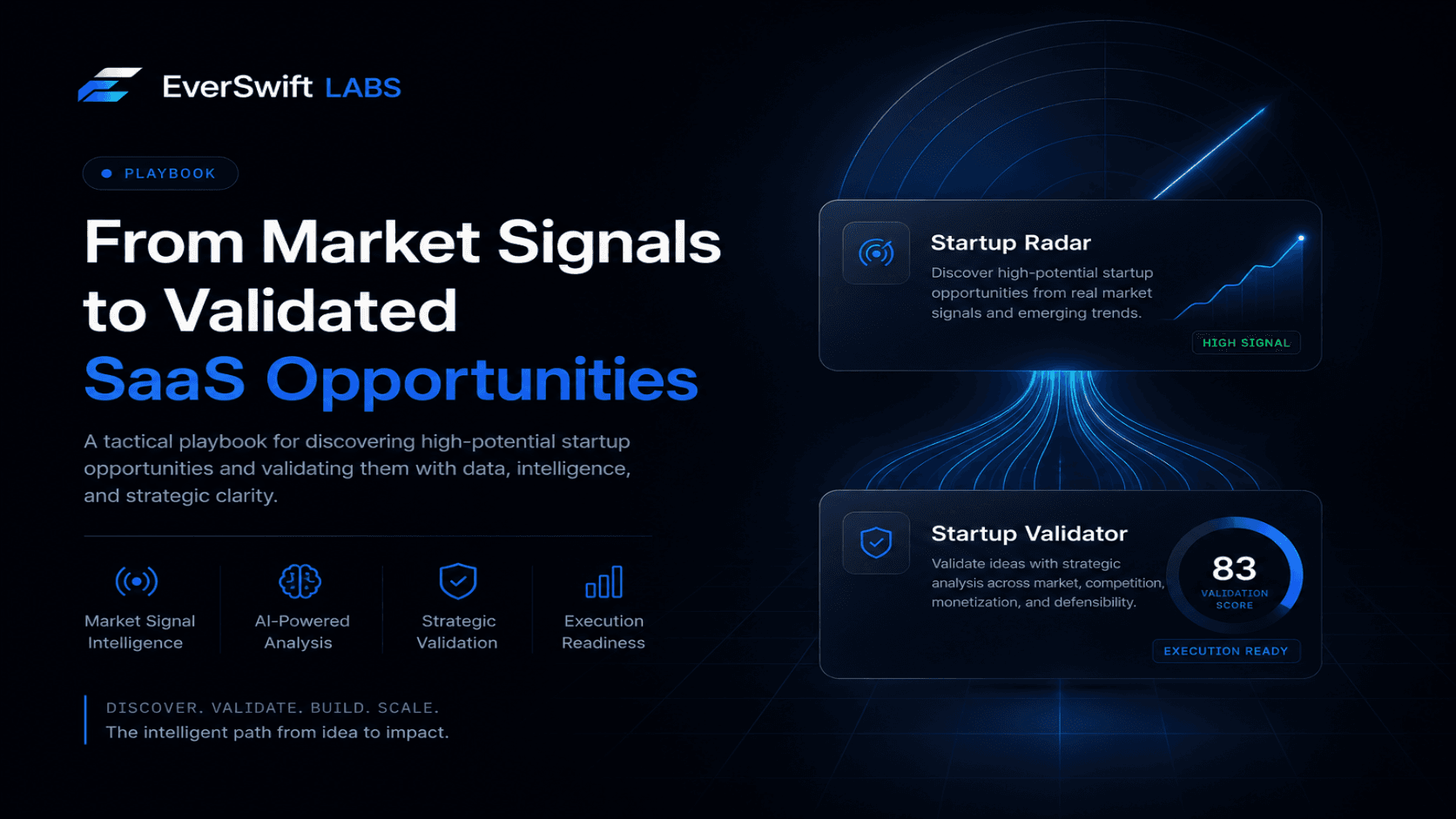
The Everswift Startup Intelligence Workflow
Modern SaaS founders do not fail because they cannot build software.
They fail because they build products disconnected from:
- real market pain
- monetization potential
- timing
- distribution feasibility
- defensibility
Traditional startup validation workflows are slow, subjective, and heavily reliant on intuition. Founders typically move from:
- random idea
- to MVP
- to months of execution
- before discovering the market never truly existed.
Everswift Labs approaches startup validation differently.
Instead of treating startup ideation as creative brainstorming, the system treats it as:
operational intelligence analysis.
The Everswift workflow combines:
- live market signal aggregation
- AI-assisted opportunity synthesis
- strategic validation systems
- defensibility analysis
- monetization diagnostics
- positioning refinement
The result is a structured founder intelligence system designed to reduce wasted execution cycles before product development begins.
Core Thesis
The highest leverage startup ideas are not discovered through inspiration.
They are discovered through:
- repeated market friction
- operational inefficiencies
- underserved workflows
- growing behavioral shifts
- emerging infrastructure gaps
Most founders search for ideas.
Modern operators should instead search for:
signal density.
The Everswift framework is built around one core principle:
High-intensity recurring pain
+
Clear monetization path
+
Growing market timing
+
Weak operational tooling
=
High-potential SaaS opportunity
This changes startup discovery from:
- speculative ideation to:
- intelligence-driven opportunity analysis.
System Architecture
The Everswift startup intelligence workflow operates as a connected operational pipeline.
Market Signals
↓
Signal Filtering
↓
Opportunity Synthesis
↓
Startup Validation
↓
Positioning Analysis
↓
Monetization Analysis
↓
Execution Decision
The workflow is currently powered by two interconnected systems:
Startup Radar
↓
Startup Validator
Startup Radar identifies emerging opportunities.
Startup Validator determines whether those opportunities deserve execution.
Together, they create an intelligence loop that compresses weeks of founder research into minutes.
Startup Radar
What Startup Radar Does
Startup Radar is a live opportunity intelligence platform that surfaces high-potential startup opportunities based on real-world market signals.
Unlike generic AI idea generators, Startup Radar does not invent startup concepts from thin air.
It synthesizes opportunities from:
- developer communities
- founder discussions
- operational complaints
- workflow bottlenecks
- infrastructure friction
- emerging AI adoption patterns
The platform functions as:
a founder intelligence feed.
Signal Sources
Startup Radar continuously aggregates signals from:
- Reddit discussions
- HackerNews
- Product Hunt
- niche RSS feeds
- founder communities
- social platforms
- operational SaaS discussions
The system prioritizes:
- repeated pain
- urgency
- monetization likelihood
- infrastructure inefficiency
- workflow repetition
Signals are filtered aggressively to reduce:
- hype cycles
- low-quality trends
- novelty noise
- shallow consumer ideas
Startup Radar Workflow
Stage 1 — Signal Collection
Raw market discussions are collected continuously from external sources.
Example inputs:
- operational complaints
- workflow inefficiencies
- AI implementation friction
- manual process bottlenecks
Stage 2 — Signal Scoring
Signals are scored based on:
- engagement intensity
- operational urgency
- market repetition
- monetization potential
- infrastructure depth
Example classifications:
- Critical Signal
- Emerging Opportunity
- Stable Infrastructure Need
Stage 3 — Opportunity Synthesis
The system converts raw pain points into structured SaaS opportunities.
Example output:
Agentic Desktop Automation and GUI Interaction Tool
Instead of presenting vague startup ideas, the system provides:
- opportunity framing
- market timing
- monetization angle
- strategic rationale
- top pain points
- infrastructure opportunity analysis
Operational Intelligence Panels
Each Startup Radar opportunity includes structured analysis sections.
Why This Opportunity Exists
Explains:
- underlying workflow friction
- operational inefficiencies
- infrastructure gaps
Example: Legacy enterprise software lacking APIs creates repetitive manual labor requirements.
Why Now
Explains:
- technological timing
- behavioral shifts
- infrastructure maturity
- AI capability improvements
Example: Advancements in multimodal AI systems enable interaction with traditional desktop interfaces.
Suggested SaaS Angle
Provides:
- monetization structure
- business model direction
- operational implementation ideas
Signal Evidence
Startup Radar includes real signal references extracted from live data sources.
This grounds opportunities in:
observable market behavior.
The platform avoids speculative startup generation by attaching:
- source references
- engagement context
- market discussions
- operational examples
Startup Radar Infrastructure
Frontend
- Next.js App Router
- Tailwind CSS
- dark-mode analytical UI
- modular intelligence panels
Backend
- autonomous scraping workers
- signal parsing systems
- AI opportunity synthesis pipelines
Database
- Supabase PostgreSQL
- signal indexing
- opportunity scoring storage
- historical trend tracking
AI Layer
LLM systems are used for:
- signal filtering
- opportunity synthesis
- market categorization
- monetization reasoning
- trend classification
The AI layer prioritizes:
- operational depth
- market realism
- execution viability
Startup Validator
What Startup Validator Does
Startup Validator is a strategic startup analysis engine designed to evaluate:
- market viability
- monetization strength
- defensibility
- saturation
- retention potential
- distribution feasibility
The system is intentionally:
brutally analytical.
The objective is not founder motivation.
The objective is:
execution risk reduction.
Validation Workflow
Stage 1 — Founder Input
Users provide:
- startup idea
- audience
- pricing model
- business model
The system intentionally minimizes friction to encourage rapid iteration.
Stage 2 — Strategic Evaluation
The validation engine analyzes:
- market conditions
- competitive saturation
- switching costs
- retention likelihood
- urgency
- SEO opportunity
- virality potential
- structural defensibility
Stage 3 — Verdict Generation
The system generates:
- validation score
- strategic verdict
- execution diagnostics
- risk vectors
- monetization analysis
- positioning refinement
Example verdicts:
- GO
- PIVOT
- AVOID
Validation Diagnostics
The platform surfaces operational weaknesses directly.
Example categories:
- Market Saturation
- SEO Opportunity
- Distribution Difficulty
- Retention Strength
- Switching Costs
- Monetization Viability
These metrics help founders identify:
structural business weaknesses before execution.
Brutal Truth Layer
The validator intentionally includes direct strategic criticism.
Example:
You are not building a company.
You are building a UI layer on top of existing browser functionality.
This section exists to:
- expose weak assumptions
- reduce emotional bias
- improve strategic clarity
Engineered Positioning
The platform reframes vague ideas into stronger operational positioning.
Example:
Before:
A tab manager for freelancers
After:
A context-switching utility for high-intensity knowledge workers
This improves:
- category clarity
- premium positioning
- perceived strategic depth
Action Plan System
Each validation includes:
- tactical next steps
- pivot recommendations
- execution constraints
- implementation guidance
The system avoids:
- generic startup advice
- motivational recommendations
- vague AI-generated filler
Startup Validator Infrastructure
Frontend Stack
- Next.js
- Tailwind CSS
- modular intelligence UI
- animated verdict systems
- structured analysis sections
Backend Stack
- server actions
- validation orchestration pipelines
- structured JSON outputs
- Supabase persistence layer
AI Validation Engine
The validation engine evaluates:
- market viability
- defensibility
- urgency
- monetization strength
- operational complexity
The prompt architecture prioritizes:
- analytical realism
- strategic precision
- execution practicality
Why Traditional Startup Validation Fails
Most startup validation workflows fail because they rely on:
- social feedback
- founder intuition
- motivational optimism
- surface-level research
Common founder mistakes:
- validating with friends
- ignoring monetization
- underestimating distribution
- building in saturated markets
- confusing features for companies
The Everswift workflow attempts to reduce these failure modes through:
structured operational analysis.
Distribution and SEO Systems
The Everswift ecosystem is designed around compounding founder discovery.
The distribution architecture includes:
- evergreen SEO pages
- AI-answer-engine optimization
- free operational tooling
- founder-focused playbooks
- intelligence-driven content systems
The system prioritizes:
- search visibility
- AI retrieval compatibility
- structured semantic content
- long-tail founder intent
SEO and AEO Optimization Structure
The ecosystem is optimized for:
- Google AI Overviews
- ChatGPT retrieval
- Perplexity citations
- semantic search systems
Optimization layers include:
- FAQ structures
- semantic headings
- structured operational terminology
- modular information hierarchy
- long-tail founder queries
Operational Bottlenecks
No startup intelligence system is perfect.
Current limitations include:
- imperfect signal interpretation
- emerging trend uncertainty
- AI reasoning variability
- incomplete market visibility
- changing platform behavior
Additional operational challenges:
- scaling signal ingestion
- filtering low-quality noise
- maintaining data freshness
- avoiding hype-driven trend distortion
The system intentionally prioritizes:
signal quality over signal volume.
Recommended Founder Workflow
Recommended Usage Loop
1. Explore Startup Radar
↓
2. Identify repeated operational pain
↓
3. Open opportunity analysis
↓
4. Validate opportunity with Startup Validator
↓
5. Analyze defensibility and monetization
↓
6. Refine positioning
↓
7. Decide whether execution is justified
This workflow is designed to reduce:
- impulsive execution
- weak positioning
- low-value SaaS development
- unscalable business models
Infrastructure Philosophy
Everswift Labs treats startup building as:
operational systems engineering.
The focus is not:
- rapid idea generation
- motivational founder content
- shallow AI wrappers
The focus is:
- leverage
- infrastructure
- scalability
- execution quality
- operational intelligence
FAQ
What is Startup Radar?
Startup Radar is a live market intelligence platform that identifies high-potential startup opportunities from real-world operational signals and market friction.
What makes Startup Radar different from AI idea generators?
Startup Radar does not generate random ideas.
It synthesizes opportunities from:
- live discussions
- operational complaints
- infrastructure gaps
- market demand signals
What does Startup Validator analyze?
Startup Validator analyzes:
- monetization viability
- competition
- defensibility
- SEO opportunity
- market saturation
- distribution complexity
- retention potential
Why does Startup Validator give harsh feedback?
The platform prioritizes execution realism over motivational feedback.
The goal is to identify structural weaknesses before founders invest significant time and capital.
Can Startup Radar identify emerging SaaS trends?
Yes.
The system continuously monitors:
- founder communities
- developer ecosystems
- AI infrastructure discussions
- workflow bottlenecks
- operational inefficiencies
to identify emerging opportunities.
Is the Everswift workflow designed for AI-native startups?
Primarily yes.
The system performs best when evaluating:
- AI infrastructure products
- operational SaaS
- workflow automation
- vertical SaaS
- developer tooling
- AI-enabled operational systems
How do Startup Radar and Startup Validator work together?
Startup Radar identifies opportunities.
Startup Validator determines whether those opportunities deserve execution.
Together they create a structured startup intelligence workflow.
What comes after validation?
The next stages typically include:
- positioning refinement
- pricing architecture
- distribution planning
- landing page optimization
- execution infrastructure
Why does Everswift Labs focus heavily on systems?
Because scalable businesses are built through:
- repeatable workflows
- operational leverage
- infrastructure quality
- distribution systems
not isolated tactics.
